 Back
to smoking and disease
Back
to smoking and disease
 The diagram
on the right depicts many of the different body sites adversely affected
by tobacco smoking. The risk of developing lung and other smoking related
cancers is related to total lifetime exposure to cigarette smoke, as measured
by the number of cigarettes smoked each day, the age at which smoking began,
and the number of years a person has smoked. Passive smoking (exposure
of nonsmokers to cigarette smoke from smokers) is responsible for several
thousand lung cancers a year in non-smokers. In 1992, the EPA classifed
passive smoke as a Group A (known human) carcinogen (cause of cancer).
It is also linked to severe respiratory problems in infants and young children.
Stillbirths and low birth weights are related to smoking. The only good
news is a smoker's risk begins to decrease immediately after quiting and
continues to decline gradually every year. The National Cancer Institute
has several monographs in smoking including a recent 389 page monograph
by more than 87 experts. It discusses topics such as smoking cessation
counseling, prevention and control and adolescent smoking prevention. The
public may obtain single copies free from NCI's Cancer Information Service
at 1-800-4-CANCER (1-800-422-6237).
The diagram
on the right depicts many of the different body sites adversely affected
by tobacco smoking. The risk of developing lung and other smoking related
cancers is related to total lifetime exposure to cigarette smoke, as measured
by the number of cigarettes smoked each day, the age at which smoking began,
and the number of years a person has smoked. Passive smoking (exposure
of nonsmokers to cigarette smoke from smokers) is responsible for several
thousand lung cancers a year in non-smokers. In 1992, the EPA classifed
passive smoke as a Group A (known human) carcinogen (cause of cancer).
It is also linked to severe respiratory problems in infants and young children.
Stillbirths and low birth weights are related to smoking. The only good
news is a smoker's risk begins to decrease immediately after quiting and
continues to decline gradually every year. The National Cancer Institute
has several monographs in smoking including a recent 389 page monograph
by more than 87 experts. It discusses topics such as smoking cessation
counseling, prevention and control and adolescent smoking prevention. The
public may obtain single copies free from NCI's Cancer Information Service
at 1-800-4-CANCER (1-800-422-6237). 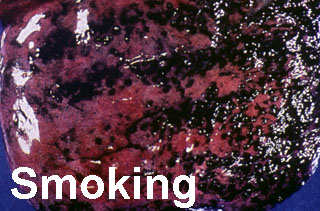
JAMA (Journal of the American Medical Association) has published in mid 1995 a series of summaries of internal documents of two tobacco companies. The documents were given to the UCSF library, where they are now archived and available to the public. A California court has supported the universities decision to make the documents available to the public. These documents clearly show the companies have known for many years about the cancer causing effects of smoking, the addictive nature of nicotine, and have targeted our children for addiction. The photo above left is a lung with a lot of carbon pigment deposition. This was caused by smoking. A normal lung is uniformly pink.